
Why read this article?
Investors and asset owners frequently face key questions when structuring operations models and governance frameworks. This article addresses some of the most common and critical considerations that guide these decisions:
- What is the right Operations Model to protect and act in the best interest of the Project Company?
- Which model and governance structure can ensure transparency, foster cooperation, and incentivise effective decision-making?
- Do the proposed terms reflect established market and contractual standards?
- Does the Operator Agreement provide the necessary risk-allocation framework and operational value while still allowing the Project Company to update its O&M strategy and perform market testing?
By exploring these questions, this article helps you understand how to structure your operations model to balance risk, performance, and long-term value.
No Single Model Fits Every Project
Generally, it is difficult to define a single market standard for the Operations Model. Several Operating Models exist for large wind projects, and no one-model-fits-all approach applies to JV Project constellations, because:
- The Operations Model shall reflect the O&M Strategy selected by the JV shareholders based on their capabilities, competitive advantages, strategic goals, technology choices, market conditions, financing structure, and contractual landscape.
- The Operator Agreement is shaped not only by the Operations Model but also by the JV governance framework, the scope of services, the fee model, risk-allocation mechanisms, and the degree of operational flexibility.
Below, we introduce and explore four (4) typical Operating Models, noting that the other variations and hybrid configurations are also used across the sector.
1. Full Scope under Owner Operator
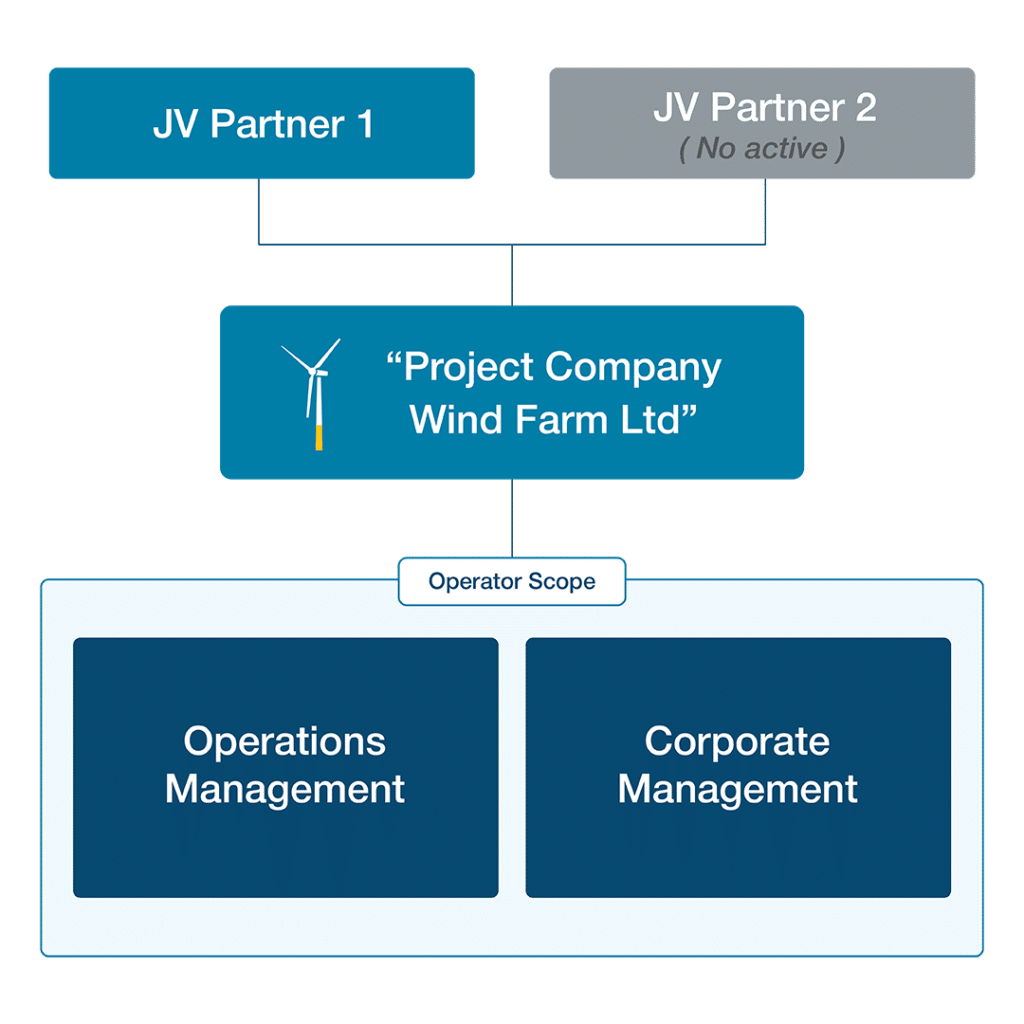
• The Operator, affiliated with one JV Partner, delivers the full scope of services.
• The other JV partners are not active in day-to-day decisions.
2. Project Signing Key O&M Contracts, with Owner Operator as Manager
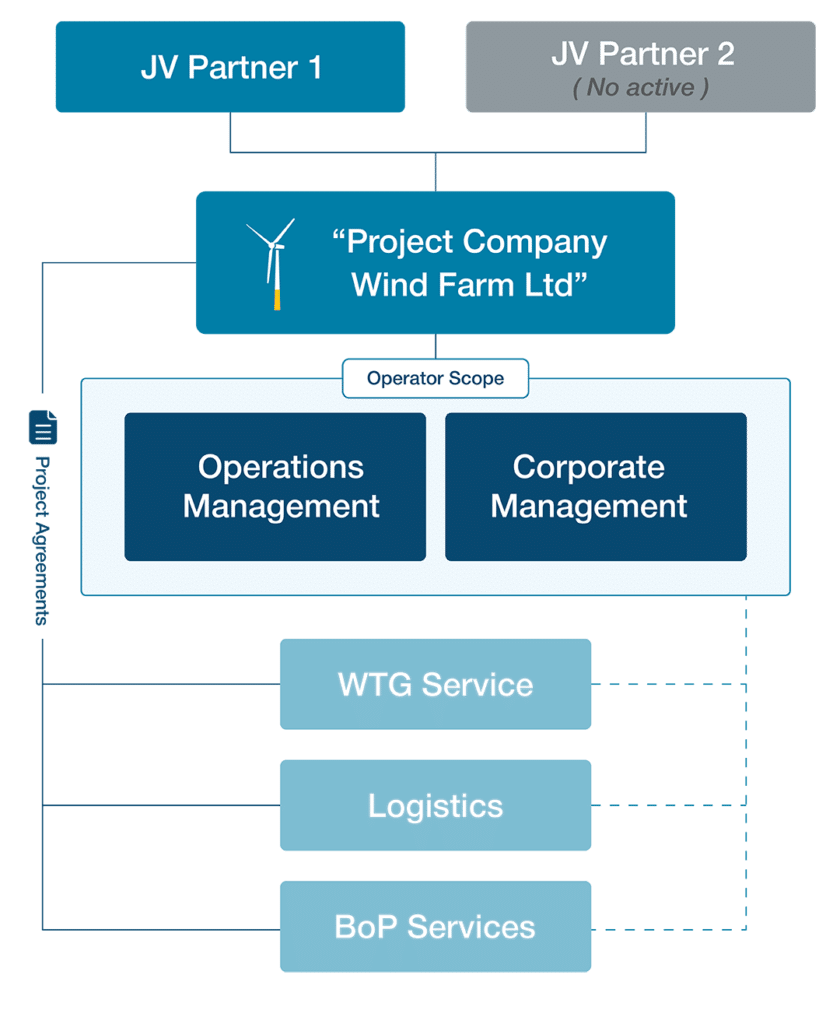
• The Operator, affiliated with one JV Partner, manages the full scope of services.
• Key O&M agreements (e.g. WTG Service, Logistics) are decoupled and contracted directly by the Project Company.
3. Lean and Independent General Manager / Asset Management

• An Independent General Manager appointed by the Project Company, establishes KPIs, drives Operator performance, and serves as the main stakeholder and regulatory interface.
• The Operator reports to the independent General Manager.
4. Project Signing Key O&M Contracts, with Independent Operator Reporting to Active Owner

• The Active Owner leads Asset and Corporate Management services, while an independent Operator is appointed to manage day-to-day Operations.
• Key O&M agreements (e.g. WTG Service, Logistics) are contracted directly by the Project Company.
Choosing the Right Operations Model
What is the right Operations Model for a given project? And what are the key elements to address when defining the Operations Model and, subsequently, the Operator Agreement?
Key elements to discuss and negotiate when structuring the Operations Model and Operator Agreement:
- O&M Strategy – determines the Scope of Services and Terms contracted under the Operator Agreement and the project agreements, potentially not only for a specific project but across the broader portfolio.
- Fee Model and Risk Allocation – defines the base fee, performance premiums, and the allocation of risk between Operator and the Project Company.
- Service Standards and Flexibility – sets expectations for acting in the best interest of the Project Company, including boundaries, performance level, and flexibility to efficiently deliver the service scope.
- Governance and Delegation of Authority ensures clarity on decision-making rights (aligned with the Shareholders Agreement SHA), processes, transparency obligations and expected cooperation between the parties.
Timing Considerations
Timing is essential when discussing, negotiating, and agreeing on the fundamental elements of the Operations Model and Operator Agreement
- The Operations Model and the O&M Strategy (including project- or JV- specific adaptations) are typically defined during the Development phase
- The Operator Agreement itself is a long-term contract.
- Once the agreement is in place and the project reaches financial close, there are usually only two (2) to three (3) opportunities over the full project lifecycle to introduce fundamental structural changes.
This makes early and comprehensive alignment critical to avoid misalignment later in the operational phase, including during future farm-downs.
Want to learn more about choosing the right operations model for your projects?
Reach out to our team to discuss how the right setup can optimise operations structures, enable value creation and maximise asset performance.
Juan Pinilla Lopez | Chief Consultant Get in touch
Lars Conradsen | Founding Partner Get in touch
More about PEAK Wind